
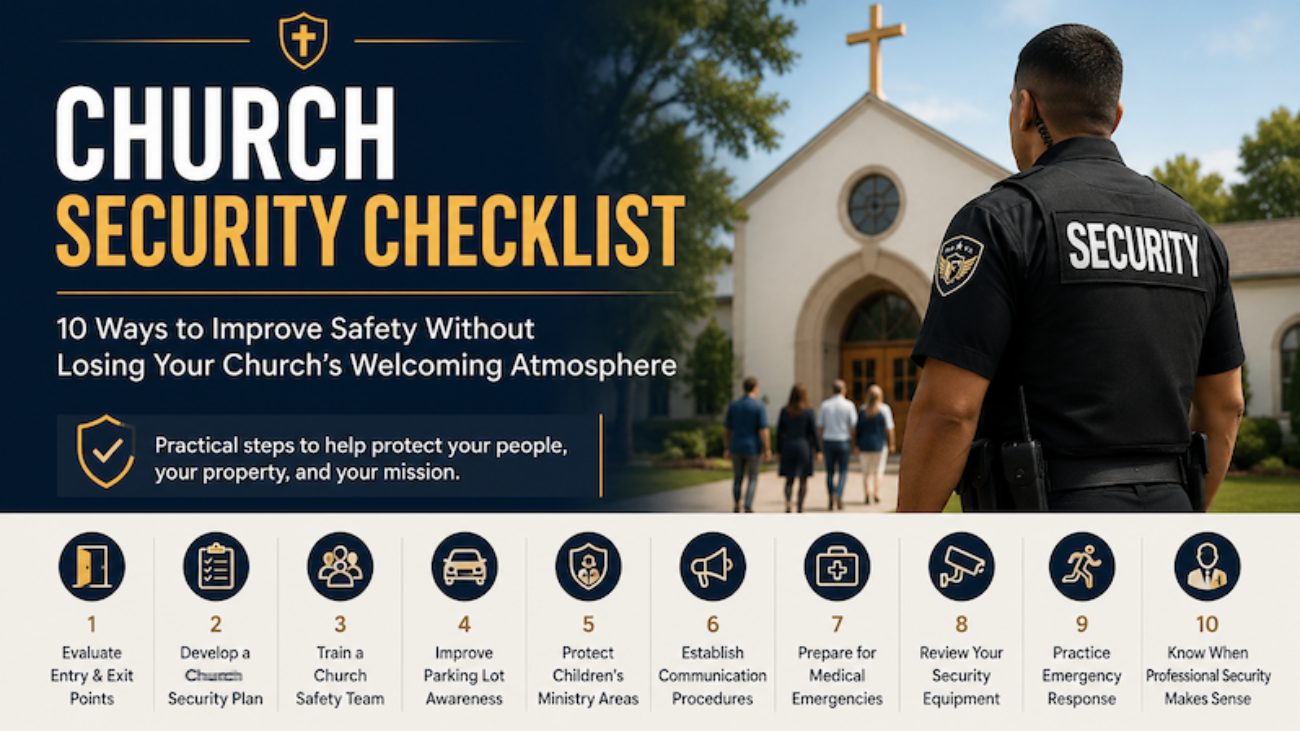
church security checklist and a security guard standing out in front of a church as people enter to worship

Church Security Checklist: 10 Ways to Improve Safety Without Changing Your Church’s Welcoming Atmosphere

Churches are meant to be places of peace, fellowship, and worship. Creating a safer environment doesn’t mean making people feel uncomfortable or turning your church into a fortress. In most cases, effective church security is built through thoughtful planning, trained people, and simple procedures that help everyone feel both welcomed and protected.

Whether your church has 100 members or several thousand, reviewing your safety practices is one of the best investments you can make for your congregation.

1. Evaluate Entry and Exit Points

Know who can enter your building and when. Consider:

  • Main entrances
  • Children’s ministry entrances
  • Emergency exits
  • Parking lot access

The goal isn’t restricting visitors, it’s understanding how people move through your campus.

2. Develop a Church Security Plan

Every church should have a written plan covering:

  • Medical emergencies
  • Fire evacuation
  • Severe weather
  • Suspicious behavior
  • Missing children
  • Security incidents

A documented plan gives volunteers and staff confidence during stressful situations.

3. Train a Church Safety Team

Many churches rely on volunteers. Even if you have a volunteer team, members should receive regular training on:

  • Observation
  • Communication
  • De-escalation
  • Emergency response
  • Reporting procedures

Training matters just as much as having willing volunteers.

4. Improve Parking Lot Awareness
Many incidents occur before people ever enter the building.

Simple improvements include:

  • Assistance for elderly members
  • Better lighting
  • Visible patrols
  • Clear signage
  • Designated traffic flow

5. Protect Children’s Ministry Areas
Children’s check-in procedures should include:

  • Controlled access
  • Identification procedures
  • Authorized pickup
  • Volunteer screening

Families notice these details.

6. Establish Emergency Communication Procedures

Ask yourself:

  • Who contacts 911?
  • Who directs first responders?
  • Who communicates with staff?
  • How do volunteers receive instructions?

Clear communication reduces confusion.

7. Prepare for Medical Emergencies

Security isn’t only about crime. Churches should be prepared for:

  • Falls
  • Heart attacks
  • Medical emergencies
  • Heat-related illness
  • Injuries during events

8. Review Your Security Equipment

Technology should support—not replace—people. Review:

  • Radios
  • Cameras
  • Lighting
  • Door hardware
  • Alarm systems

9. Practice Emergency Response

Plans that are never practiced often fail during real emergencies. Occasional training exercises help staff and volunteers become familiar with their responsibilities before an actual incident occurs.

10. Know When Professional Security Makes Sense

Some situations benefit from trained security personnel, including:

  • Large worship services
  • Holiday events
  • Conferences
  • Community outreach events
  • Churches with multiple campuses
  • Congregations that have experienced previous incidents

Professional security can complement volunteer efforts by providing visible presence, observation, and support during higher-risk situations.


Final Thoughts

Church security isn’t about creating fear; it’s about preparing responsibly so your congregation can focus on worship, fellowship, and serving the community with confidence.

Small improvements made consistently can strengthen safety while preserving the welcoming environment that makes every church unique. Whether you’re reviewing your emergency procedures, developing a volunteer safety team, or considering professional security services, taking proactive steps today can make a meaningful difference tomorrow.

If your church is evaluating its current safety procedures or planning for upcoming events, a professional Church Security Assessment can help identify opportunities to improve your existing plan while preserving the welcoming atmosphere your congregation values.

For more information, explore our Church Security Services page to learn how The Finest International Security partners with churches throughout Southern California. You may also find our articles on School Security and Event Security in San Diego helpful as you continue developing a comprehensive safety strategy for your organization.

For additional guidance on emergency preparedness and community safety, churches may also benefit from reviewing resources provided by the Cybersecurity and Infrastructure Security Agency (CISA) and the Federal Emergency Management Agency (FEMA), both of which offer planning materials that can complement your church’s overall emergency preparedness efforts.
does my property need private security

How to Know When Your Property Actually Needs Private Security

Most property owners don’t wake up one morning and decide they need private security. Usually, it happens more gradually.

A few complaints come in. A trespassing issue pops up. Construction starts.
A property begins feeling harder to control after hours.
An event draws more people than expected.
Or maybe nothing major has happened yet, but there’s a growing sense that things are becoming more exposed than they used to be.

That’s usually the real turning point. Not disaster. Not panic. Just the quiet realization that your property has moved beyond “we’re probably fine” and into “we should probably get ahead of this.”

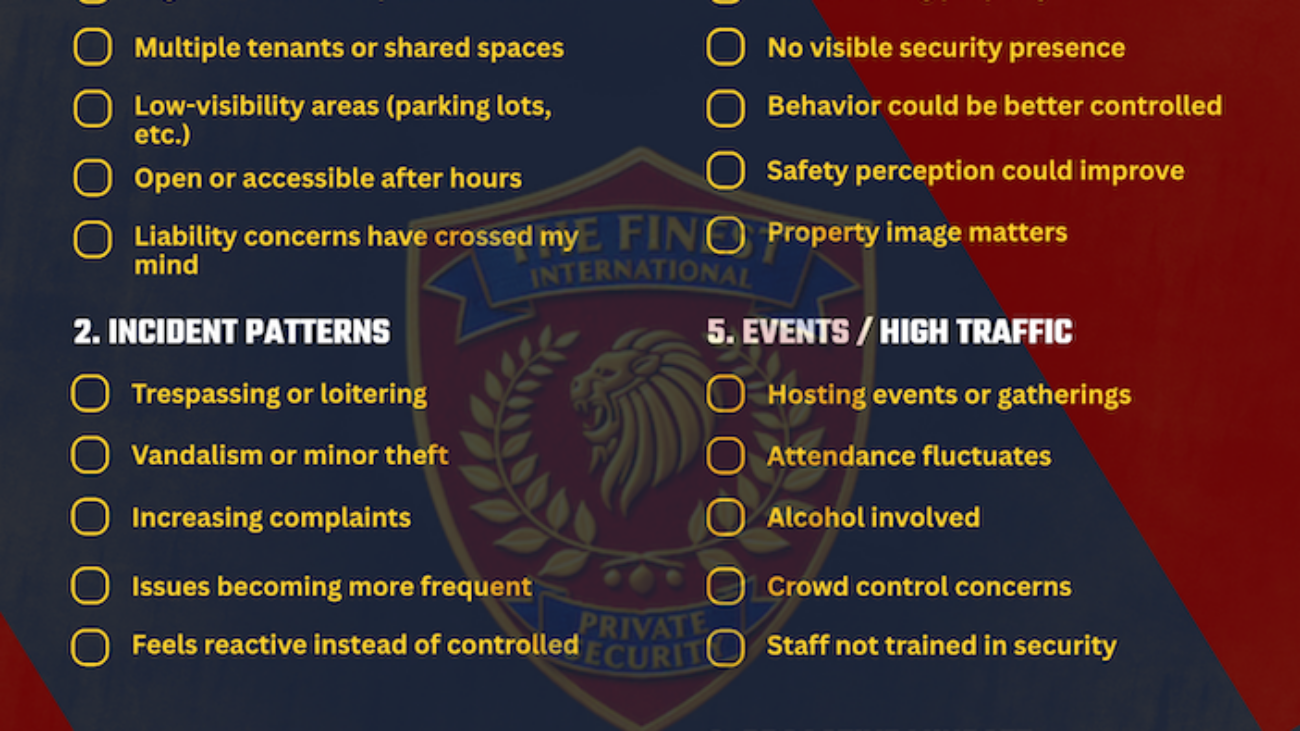
That’s exactly why we created our Property Security Readiness Checklist — to help property owners, managers, HOAs, and site supervisors recognize when professional security simply makes sense.

Security Is Usually Hired Too Late

One of the biggest mistakes people make is treating private security like something you only bring in after a serious issue happens.

But in reality, the best use of security is often prevention.

Once theft, vandalism, loitering, unauthorized access, or safety concerns become frequent enough to affect your operations, image, or peace of mind, you are already paying a price — whether you’ve hired security or not.

That price may show up as:

  • property damage
  • delays
  • complaints
  • liability concerns
  • tenant frustration
  • reputation issues
  • staff stress
  • avoidable disorder

Professional security is often less about reacting to one major incident and more about preventing a long string of smaller ones from turning into a bigger problem.

Start With Risk and Exposure

The first thing to look at is not whether something bad has already happened.

It’s whether your property has become more vulnerable than it used to be. Some of the clearest signs include:

  • high foot traffic or public access
  • multiple tenants or shared spaces
  • low-visibility areas like parking lots or side access points
  • after-hours accessibility
  • general liability concerns

This is where many commercial properties, apartment communities, HOAs, mixed-use spaces, and job sites begin to quietly outgrow “normal oversight.”

Because once access becomes harder to control, risk becomes harder to control too.

Patterns Matter More Than One-Off Incidents

A single issue doesn’t always mean you need security.

A pattern usually does.

If your property is seeing repeated signs like:

  • trespassing or loitering
  • vandalism
  • minor theft
  • recurring complaints
  • situations that feel increasingly reactive instead of controlled

…it may be a sign that the property needs more structure than the current setup is providing. This is one of the most overlooked parts of security planning. People tend to normalize recurring issues for too long. But if something keeps happening, that is not “just part of owning property.”
That is information. And usually, it’s information worth acting on.

Construction and Temporary Risk Are Common Triggers

One of the clearest times to bring in private security is during temporary high-risk periods.

That includes situations like:

  • active construction or renovation
  • materials or equipment left on site overnight
  • multiple access points opened during work
  • reduced after-hours oversight
  • job delays that would become expensive if something went wrong

Construction projects, tenant improvements, vacant unit turnovers, and building upgrades often create short-term vulnerability that many owners underestimate. And that’s often when theft, unauthorized access, and liability issues show up. Temporary risk still creates real risk.

Visible Security Presence Changes Behavior

Not every property needs armed presence or a heavy security footprint. But many properties do benefit from something much simpler:

visible control.
A visible security presence can help with:

  • deterrence
  • behavior management
  • resident or tenant confidence
  • stronger perception of order
  • improved professionalism across the property

This is especially important for public-facing properties or sites where image matters. Because whether owners like it or not, people make assumptions based on what a property feels like the moment they arrive. And if a property feels unmanaged, exposed, or loosely controlled, that affects more than just safety; it affects trust.

Events and High-Traffic Situations Change the Equation

Some properties only need added security at specific times.

Events, gatherings, fluctuating attendance, alcohol service, weekend activity, or high visitor volume can all create temporary security concerns that normal staffing is not built to handle. That does not mean something is wrong. It just means the environment has changed.

And when the environment changes, the level of oversight often needs to change with it. This is where professional security can help support crowd awareness, access flow, general deterrence, and overall control without turning the atmosphere into something aggressive or uncomfortable.

The Best Time to Bring in Security Is Before You’re Forced To

This is really what it comes down to. The best time to improve security is not after the damage.

Not after the liability issue.
Not after the complaints stack up.
Not after the property has already become reactive.

The best time is when the warning signs are present, but still manageable. That is when security does its best work. Because the value of private security is not just in responding to incidents. It is in helping reduce the chance that those incidents happen in the first place.

A Simple Way to Know Where You Stand

That is exactly why we created our Property Security Readiness Checklist. It is a simple tool designed to help property owners, HOAs, managers, and project leads identify whether their site may already be showing signs that professional security would be a smart move.

It covers areas like:

  • property exposure
  • repeat incidents
  • temporary construction risk
  • visibility and control
  • event-related concerns
  • proactive planning

Sometimes the signs are obvious. Other times, they are easier to recognize once they are all in one place.

Download Our Free Security Checklist

If you’re responsible for a property, community, site, or commercial space, this checklist is a simple way to evaluate whether it may be time to strengthen your security strategy.

Download our free security checklist and get a clearer picture of whether your property is operating from prevention or drifting toward damage control.